
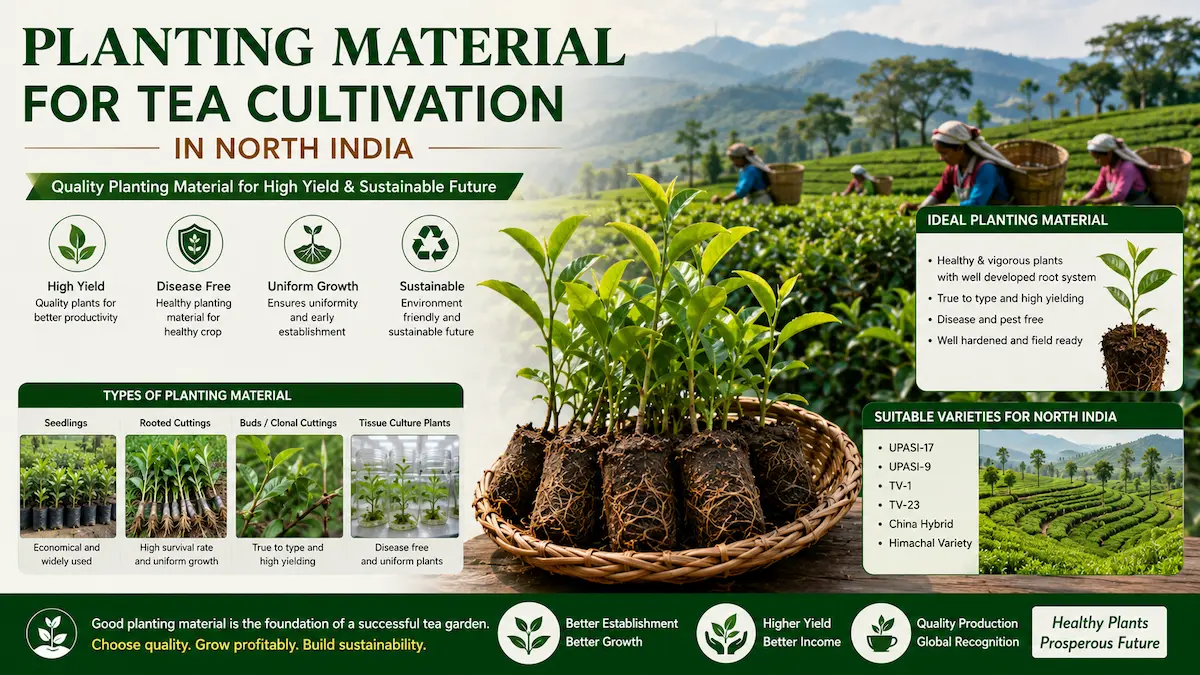

Choice of Planting material for Tea Cultivation in North India is a very important subject and requires a well-thought strategy for fulfilling the ever-growing demand for tea production and replacing economically nonviable old tea plants.
We require a prolonged strategy to increase tea production.
Aside from water, tea is the most popular beverage in the world and there are 10 top tea producing countries, which are China, India, Kenya, Sri Lanka, Vietnam, Turkey, Indonesia, Myanmar, Iran, and Bangladesh.
Tea is believed to have originated in China and spread to other countries.
India is one of the big tea producers and exporter of tea. It produces around 1350000tonnes of each year.
In India, The British East India Company started tea planting and now there are over one billion tea drinkers and 70% of tea produced in India is consumed by the Indian population itself. All over the world Tea is consumed in two ways – with milk or without milk. In India, it is consumed mostly with milk.
To produce quality tea with the high production target, it would be necessary to improve upon the existing tea areas through improvement in the cultural practices as well as developmental plans for rejuvenation, infilling, replanting, and extension planting.
Among others, the potentiality of plants and conditions of soil plays a vital role in the productivity of tea crops. Improvements in the soil are a slow and long-run process and a complete change of conditions is virtually not possible. As more than 60 percent area of the existing tea is occupied by inherently inferior tea planting material, an increase in productivity could be achieved by replacing them with proven planting materials suited to different agro-climatic conditions of N.E. India.
Generally improved planting materials having the potentiality of good quality, higher yields, tolerance to drought, waterlogging, pests and diseases are available. During the last many years many TV clones and biclonal seed stocks have also been developed by the industry. Now it is important to adopt a sound policy towards the choice of planting material to increase the productivity of quality tea, based on the available information on the clones and biclonal seed stocks.
Guidelines for selecting the right tea planting Material
- Tea planting material with proven quality and yield should be selected.
- In no circumstances, the number of each clone and seed grown in a tea garden should be less than five.
- For a large scale tea plantation, tea clones or tea seed stocks of diverse genetic origin should be cultivated.
- No tea planting material should occupy more than 10 % area of the estate.
- Suitability of cultivars for a particular locality should be judged by growing them on an exploratory basis.
- Preference of tea varieties for CTC/orthodox manufacture may be considered at the time of selection of clones.
- A blend of quality, standard, and yield clones should be in the proportion of 50:30:20 while selecting planting material in a tea garden.
Characteristics of TV series Tea clones
| Cultivar | Ist Preference | 2nd Preference | Drought response |
| TV 1 | CTC | ORTHODOX | TOLERANT |
| TV 2 | ORTHODOX | CTC | SUSCEPTIBLE |
| TV 3 | ORTHODOX | CTC | SUSCEPTIBLE |
| TV 4 | ORTHODOX | CTC | SUSCEPTIBLE |
| TV 5 | ORTHODOX | CTC | SUSCEPTIBLE |
| TV 6 | ORTHODOX | CTC | HIGHLY SUSCEPTIBLE |
| TV 7 | ORTHODOX | CTC | MOD. SUSCEPTIBLE |
| TV 8 | SUITABLE FOR BOTH | ORTHODOX | HIGHLY SUSCEPTIBLE |
| TV 9 | CTC | ORTHODOX | MOD. TOLERANT |
| TV 10 | CTC | ORTHODOX | MOD. TOLERANT |
| TV 11 | ORTHODOX | CTC | MOD. TOLERANT |
| TV 12 | ORTHODOX | CTC | MOD. TOLERANT |
| TV 13 | ORTHODOX | CTC | SUSCEPTIBLE |
| TV 14 | CTC | ORTHODOX | |
| TV 15 | ORTHODOX | ORTHODOX | SUSCEPTIBLE |
| TV 16 | CTC | ORTHODOX | MOD. TOLERANT |
| TV 17 | CTC | ORTHODOX | TOLERANT |
| TV 18 | CTC | ORTHODOX | MOD. TOLERANT |
| TV 19 | CTC | ORTHODOX | |
| TV 20 | CTC | ORTHODOX | TOLERANT |
| TV 21 | ORTHODOX | CTC | SUSCEPTIBLE |
| TV 22 | CTC | ORTHODOX | TOLERANT |
| TV 23 | CTC | ORTHODOX | |
| TV 24 | CTC | ORTHODOX | MOD. TOLERANT |
| TV 25 | CTC | ORTHODOX | TOLERANT |
| TV 26 | CTC | ORTHODOX | TOLERANT |
| TV 27 | CTC | ORTHODOX | MOD. TOLERANT |
| TV 28 | CTC | ORTHODOX | MOD. TOLERANT |
| TV 29 | CTC | ORTHODOX | MOD. TOLERANT |
| TV 30 | CTC | ORTHODOX | MOD. TOLERANT |
Characteristics of Garden series clones and Area wise Recommendations
Assam: South Bank
| CLONE | 1ST PREFERENCE | 2ND PREFERENCE | RESPONSE TO DROUGHT |
| HEELEAKAH 2314 | ORTHODOX | CTC | MOD. SUSCEPTIBLE |
| HEELEAKAH 2315 | SUITABLE FOR BOTH | CTC | MOD. SUSCEPTIBLE |
| HEELEAKAH 2319 | ORTHODOX | CTC | MOD. SUSCEPTIBLE |
| HEELEAKAH 2336 | ORTHODOX | CTC | MOD. SUSCEPTIBLE |
| HEELEAKAH 22/14 | ORTHODOX | CTC | MOD. SUSCEPTIBLE |
| GOTOONGA 20 | SUITABLE FOR BOTH | CTC | – |
| GOTOONGA 20 | SUITABLE FOR BOTH | CTC | MOD. SUSCEPTIBLE |
| SANGSUA 6 | ORTHODOX | CTC | MOD. SUSCEPTIBLE |
| SANGSUA 28 | ORTHODOX | CTC | MOD. SUSCEPTIBLE |
| AMLUCLE 8 H | ORTHODOX | CTC | – |
| DOORIA 4 | ORTHODOX | CTC | – |
| DOORIA 15 | ORTHODOX | CTC | – |
ASSAM – NORTH BANK
| Cultivar | Ist Preference | 2nd Preference | Drought response |
| CHOIBARI 38 | ORTHODOX | CTC | MOD. TOLERANT |
| CHOIBARI 43 | ORTHODOX | CTC | MOD. TOLERANT |
| GOHPUR | ORTHODOX | CTC | SUSCEPTIBLE |
| NAGRIJULI 5/70 | ORTHODOX | CTC | MOD. TOLERANT |
| TARAJULI 34 | ORTHODOX | CTC | MOD. TOLERANT |
| SEAJULI 8 | ORTHODOX | CTC | – |
| MAZBAT 107 | ORTHODOX | CTC | – |
| BAMAJAN 19 | ORTHODOX | CTC | TOLERANT |
ASSAM CACHAR
| Cultivar | Ist Preference | 2nd Preference | Drought response |
| NARSINGPARE 4 | CTC | ORTHODOX | – |
| NARSINGPARE 18 | CTC | ORTHODOX | – |
| NARSINGPARE 22 | CTC | ORTHODOX | – |
| CHANDIGHAR 9 | CTC | ORTHODOX | – |
TRIPURA
| Cultivar | Ist Preference | 2nd Preference | Drought response |
| HUPLANGHERRA 18 | CTC | ORTHODOX | – |
| HUPLANGHERRA 18 | CTC | ORTHODOX | – |
| MEGHILBUNDH 11 | CTC | ORTHODOX | – |
| MEGHILBUNDH 11 | CTC | ORTHODOX | – |
WEST BENGAL- DOOARS
| Cultivar | Ist Preference | 2nd Preference | Drought response |
| HANTAPARA 12 | SUITABLE FOR BOTH | – | |
| HANTAPARA 30 | CTC | ORTHODOX | – |
| HULDIBARI 19 | CTC | ORTHODOX | |
| TUTURI 22 | SUITABLE FOR BOTH | – | |
| LEESH RIVER 9/34 | CTC | ORTHODOX | – |
WEST BENGAL – TERAI
| Cultivar | Ist Preference | 2nd Preference | Drought response |
| MAHARGUNG & GULMA 25 | CTC | ORTHODOX | – |
| SANYASITHAN 8 | ORTHODOX | CTC | – |
| SUKNA 7 | ORTHODOX | CTC | – |
| KAMALPUR 6 | CTC | ORTHODOX | – |
WEST BENGAL – DARJEELING
| Cultivar | Ist Preference | 2nd Preference | Drought response |
| PHOOBSERING 312 | ORTHODOX | ORTHODOX | – |
| BANNOCKBURN 157 | ORTHODOX | ORTHODOX | – |
| TUKDAH 145 | ORTHODOX | ORTHODOX | – |
| LINGIA 12 | ORTHODOX | ORTHODOX | – |
Tea Planting Material for Unfavorable conditions
Tea planting materials suitable for unfavorable conditions like marginal land, drought, and poor drainage are as follows:
| CONDITION | FOR PLAINS | FOR HILLS |
| MARGINAL LANDS | TS462 TS463 TS464 TS450 TS449 TS397 | TV19 TS379 |
| DROUGHT | TV1 TV9 TV10 TV11 TV14 TV16 TV18 TV19 TV20 TV22 TV25 TV27 TV30 TS397 TS449 TS589 | PHOBSERING312 TUKDAH145 TV14 LANGREE51 TS378 TS379 |
| INFILLING AND INTERPLANTING | TV9 TV18 TV25 TV26 TV22 TV23 TEENALI17/1/54 TV30 TS462 TS450 TS463 | TUKDAH78 RUNGLI RUNGLIOT4/5 TV19 HAPPY VALLEY39 PHOBSERING1258 TS379 TS378 TS557 TS569 |
GUIDELINE FOR ADOPTION OF TEA PLANTING VARIETIES / CULTIVARS IN LARGE SCALE PLANTATION BY TEA INDUSTRY OF NORTH INDIA
- A Clonal population is genetically uniform and as such, it may not be adapted to all soils and climatic conditions. A clone suitable in one area may not be good in some other area. This is due to the different genetic origin of the clones. So for a large scale adoption of particular clones, exploratory planting may be done first to assess their performance.
- The adaptability of clones to various stress and or susceptibility to pests and diseases along with the inherent quality of the end product becomes a deciding factor for their large scale adoption.
- Genetic base and long term performance in respect of productivity and quality are to be considered for shortlisting planting materials from time to time.
- For infilling, fast-growing yield clones have to be used.
- A shortlisting of garden clones and biclonal seed stocks based on the above considerations have been suggested below table, however, the performance feedback on these clones from different agro-climatic conditions, Dooars in particular, is very important in reaching to a final conclusion.
Recommendations of Tea Planting Material for different North Indian regions:
| AREA | TV CLONES | BICLONAL SEED STOCKS |
| ASSAM | TV1, TV9, TV14, TV16, TV17, TV18, TV19, TV20, TV21, TV22, TV23, TV24, TV25, TV26, TV27, TV28, TV29, TV30 | TS449, TS450 TS462 TS463 TS464 TS491 TS520 TS589 TS506 |
| CACHAR AND TRIPURA | TV1 TV9 TV17 TV18 TV20 TV22 TV23, TV24, TV25, TV26, TV27, TV28, TV29, TV30 | TS491 TS462 TS463 TS464 TS506 TS520 TS589 |
| DOOARS AND TERAI | TV1, TV9, TV17, TV18, TV20, TV22, TV23, TV24, TV25, TV26, TV27, TV28, TV29, TV30 | S491 TS462 TS464 TS506 TS520 TS589 |
| DARJEELING | TV14, TV19 | TS378 TS379 TS557 TS569 |
With the quality assuming special importance it has become necessary to identify the areas which might ensure an assured quality with the existing resources without significantly compromising production. Moreover reduction in a load of chemicals be it pesticide or fertilizer has become the need of the hour.
This will not only have a positive impact on quality but also likely to reduce the cost of production significantly.
You May be Interested to visit these interesting blogs
Pingback: Best Healthy Tea in India For 2020 - The World Agriculture
Pingback: Vegetative Propagation in Tea - The World Agriculture
Ahaa, its fastidious discussion regarding this piece of writing at this
place at this webpage, I have read all that, so at this time me also commenting at this place.
Hello to every one, the contents present at this site are truly amazing for people
knowledge, well, keep up the nice work fellows.